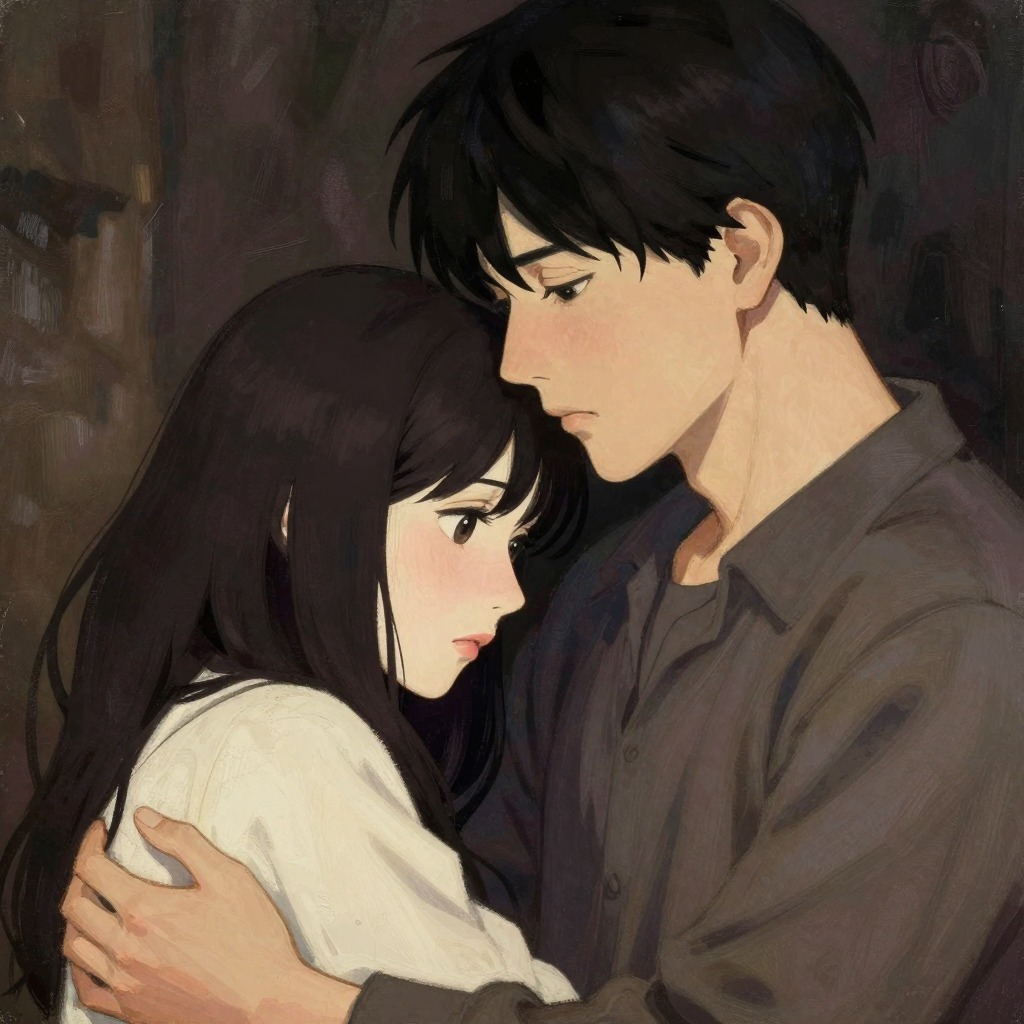
Love Flies Out the Window When Poverty Comes in the Door
Love Flies Out the Window When Poverty Comes in the Door is a proverb that Yozo, the narrator of No Longer Human, first deploys as a calculated piece of clowning on the morning after his single night of genuine happiness with Tsuneko, and that later recurs as a bitterly ironic refrain, crystallizing his conviction that material deprivation annihilates the possibility of love. The phrase, which Yozo himself calls a “crazy pronouncement,” becomes a touchstone for his deepest fear: that he is incapable of sustaining any relationship once money runs out, and that his own poverty—both financial and spiritual—dooms every bond he forms.
Origin and First Use
The proverb enters the narrative on the morning after Yozo and Tsuneko have spent the night together—a night he describes as one of “liberation and happiness,” the only time in his life he uses that word affirmatively. Waking, he is immediately seized by the old terror of intimacy and the compulsion to perform his clownish role. To break the spell and engineer a quick escape, he delivers a deliberately absurd reinterpretation of the familiar saying. “They say that love flies out the window when poverty comes in the door,” he tells Tsuneko, “but people generally get the sense backwards. It doesn't mean that when a man's money runs out he's shaken off by women. When he runs out of money, he naturally is in the dumps. He's no good for anything. The strength goes out of his laugh, he becomes strangely soured. Finally, in desperation, he shakes off the woman. The proverb means that when a man becomes half-mad, he will shake and shake and shake until he's free of a woman.” He claims this explanation is given in the “Kanazawa Dictionary,” a transparent fabrication that makes Tsuneko laugh. The speech is a masterpiece of Yozo's defensive clowning: it inverts the conventional moral of the proverb—that women are fickle and abandon a man when he is poor—and instead places the blame entirely on the man's own deterioration. It is a confession disguised as a joke, and Tsuneko, who cannot read his true meaning, laughs.
Recurrence and Thematic Weight
The phrase returns months later, after Yozo has fled Flatfish's house and become a kept man in the apartment of Shizuko, the journalist. Trapped in a state of passive dependence, he finds himself unable to work, unable to paint, and increasingly desperate for money to buy liquor and cigarettes. One day he blurts out to Shizuko, “Love flies out the window when poverty comes in the door, they say, and it's true.” She dismisses it as a “trite expression,” but Yozo is not joking. He is articulating the logic that governs his life: that his lack of money—and the shame and paralysis it produces—will inevitably drive him to abandon her, just as he abandoned Tsuneko. The proverb has become a self-fulfilling prophecy, a script he feels compelled to follow.
Connection to the Waterfall Dream and the Undrunk Glass of Absinthe
Yozo's invocation of the proverb is intimately linked to two other recurring images of lost artistic and romantic possibility. When he speaks of wanting to be a painter, he is haunted by the memory of the self-portraits he painted in high school—the “ghost pictures” that Takeichi recognized as genuine art—which have since been lost during his many moves. He calls them his “lost masterpieces” and feels a “heavy sense of loss, as if my heart had become empty.” This loss is crystallized in the image of the “undrunk glass of absinthe,” a symbol of the artistic achievement that always remains just out of reach. Similarly, when he decides to marry Yoshiko, he dreams of a future idyll: “In the spring we'd go together on bicycles to see waterfalls framed in green leaves.” This “waterfall dream” represents the pure, uncorrupted happiness he believes might be possible if he could escape his own nature. But the proverb—love flies out the window when poverty comes in the door—is the counterforce to both dreams. It is the voice that tells him that material want will shatter the waterfall dream, and that the undrunk glass of absinthe will never be tasted. The proverb, the lost ghost pictures, and the waterfall dream together form a triad of longing and failure: the art he cannot make, the love he cannot keep, and the happiness he cannot reach.
The Proverb as Self-Fulfilling Prophecy
Yozo's relationship with the proverb is not merely descriptive but performative. He does not simply observe that poverty destroys love; he actively enacts the pattern, shaking off women before they can shake off him. After the night with Tsuneko, he avoids her for a month, terrified that any further contact will lead to entanglement and eventual rejection. When he finally sees her again, in the company of Horiki, he watches passively as Horiki prepares to kiss her, thinking, “It's all over now.” He does nothing to prevent it. The proverb has become a license for inaction: because he believes love must fly out the window, he opens the window himself. This pattern repeats with Shizuko, whom he leaves after stealing her clothes to pawn for drink, and with Yoshiko, whose violation he witnesses without intervening. In each case, the proverb serves as both prediction and justification, a way of making his own cowardice and despair seem inevitable.
Significance
Love Flies Out the Window When Poverty Comes in the Door is more than a recurring line; it is the governing theorem of Yozo's emotional life. It expresses his conviction that he is fundamentally unlovable, that his poverty—not just of money but of spirit—makes him a poison to anyone who cares for him. The proverb's inversion of conventional wisdom—blaming the man rather than the woman—reflects Yozo's pathological self-blame, his inability to see himself as anything other than the source of every disaster. It is a phrase that begins as a joke, hardens into a prophecy, and ends as an epitaph for every relationship he ever had. In the end, when he is a grey-haired, morphine-addicted reject living in a seaside village, the proverb has been proven true not because the world abandoned him, but because he could not stop himself from shaking love out the window, over and over, until nothing was left.